Revitalization of Templářské Sklepy – Prague, Czech Republic

Title
Revitalization of Templářské Sklepy – Prague, Czech Republic
Website
Designed by
Novague
Image Credit
© Václav Novák
Project Description
Project Description provided by Novague - Nine Centuries of Wine Beneath Čejkovice
The caravan slowly climbs towards the oldest part of the village of Čejkovice. It passes the château and the historic wine granaries, where the road comes to an end. On a grassy plateau with a homely retreat adorned with roses, a panoramic view of the summer landscape opens up. The shimmering heat rises above the red rooftops, alternating with ribbons of greenery embroidered by rows of vines. The vines became part of this landscape long before the name Čejkovice entered history.
The first vineyards here were established by the Knights Templar at the beginning of the 13th century. During their presence in the region, they also built the oldest and most extensive medieval wine cellars in Moravia beneath the Čejkovice fortress. Their cool corridors still preserve not only wine, but also the memory of nine centuries of local winemaking tradition — a tradition shaped over time by ecclesiastical, aristocratic and state administration, but above all passed down from generation to generation as both a craft and an art.
Today, a large share of grapes from the local vineyard sites is processed by the Templářské sklepy Čejkovice wine cooperative. Founded in 1936 as a voluntary association of several dozen winemakers and grape growers, it was renewed in 1992 and now brings together approximately 340 members who collectively ensure the processing of the harvest and the distribution of their wines.
The revitalization of the oldest part of the winery represents another step in the shared effort of local winemakers to preserve their heritage. Beneath the complex, the winding corridors of medieval cellars spread like ancient roots through the underground. Along their walls run wine pipelines — the arteries distributing wine to the individual parts of the winery, whose identity is rooted in these Templar cellars.
Today, 400 metres of the approximately 650 metres of corridors are open to the public, although the original extent of the underground network is believed to have been considerably larger.
Living History Underground
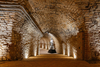
The greatest value of the historic cellars lies in their material and spatial authenticity. The revitalization primarily focused on removing inappropriate modern alterations and unnecessary decorative elements, allowing the understated beauty of the historic underground spaces to emerge.
The overall concept was created by designer Petr Novague. Into the purified space, he introduces a contemporary and clearly legible layer that enhances the unique character of the cellars. In addition to the exhibition and furnishings, he also designed a new bottle shape whose silhouette references the form of the Templar cross.
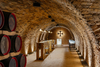
The generous vaulted spaces built from stone and brick are unified by atmospheric lighting. A subtle musical backdrop accompanies visitors through the history of the site, from Gothic motifs and the Jesuit period to the present day. The quiet atmosphere evokes the continuity of the place and the legacy of the people who have used the cellars for generations to preserve wine.
The cellar corridors are lined with dozens of oak barrels with capacities ranging from approximately 2,000 to 5,000 liters, as well as an exhibition of commemorative barrels. While smaller barrels could be transported into the cellars fully assembled, the largest ones are brought in dismantled and reconstructed on site by coopers using traditional nail-free techniques. The motifs carved into their fronts reflect individual chapters in the history of the wine cooperative.
Among the most valuable are the former largest actively used wine barrel in the Czech Republic, with a capacity of 20,250 liters, and the commemorative barrel marking the cooperative’s first decade, created in 1946. Its carved lid depicts Saint Wenceslas, the patron saint of the Czech lands, and commemorates the people connected with the foundation of the cooperative. Many of their families remain linked to the winery to this day.
The barrel was made by Eduard Pecka, one of the founders of the original cooperative and an ancestor of today’s cooper Eduard Bařina. The fifth master cooper in his family lineage, Bařina will create his third commemorative cooperative barrel in 2026 during his professional career.
Next to the historic wine archive, guarded by a statue of Saint Urban, a new exhibition titled Rosae et Lux has been created, dedicated to rosé wines. It introduces a softer, symbolically feminine element into the underground spaces.
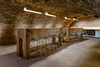
The exhibition also includes photographs, archival documents, and original labels from the founding period of the wine cooperative as well as from the decades following its nationalization. Due to the high humidity levels, the underground spaces require continuous maintenance. Sensitive exhibits are preserved in custom-designed display cases, while air quality is maintained using ozone generators.
New Layers on Ancient Roots
The new elements are conceived with restraint and respect for the character of the space. The raw materiality of the cellars is complemented by furnishings made from wood, metal and sandstone. Traditional craftsmanship meets contemporary technology, while robust details are paired with expressive minimalism. Polished steel surfaces contrast with solid timber and forged details on the oak tasting tables. Bar stools woven from slender, gleaming steel evoke the structure of medieval chainmail.
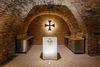
The final tasting space is dominated by a sandstone monolith subtly broken into the shape of the Templar cross. The cross motif is echoed by a large rotating logo, a strong wayfinding element that marks the intersection of the corridors and establishes the direction of the tour.
The cellars are not an exhibition of the past, but a living part of the winery — a place where craft traditions and contemporary design meet in service of the art of living.